
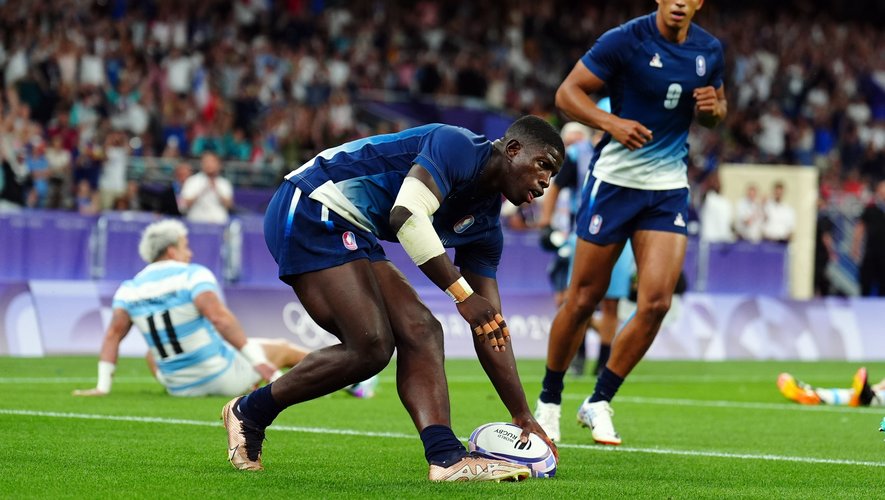
Timo’s display on Saturday for La Rochelle at Montauban was eye-catching to say the least. It was quickly evident that the man has a fine appreciation of space, and how to use it. This is a player for whom the mantra ‘play where it is easy to play’ was written. La Rochelle had come with the intention of playing, and knew that nothing less than a five point haul was required to keep their top six ambitions alive. From the first minute, when beautiful handling between prop Sclavi, Fijian lock Waqanisaravi and outside half Hastoy combined to put Nolan Le Garrec over, the intent was clear. The first try is beautiful if only for the fact that at no point does any ball-carrier seek contact. Think about that. Sclavi and Waqanisaravi are big men. Big men not seeking contact.
Timo, by today’s measures, is not a big man. At 1.92 metres tall and weighing a mere 95 kg, his morphology is remarkably similar to Oscar Jegou, the player he was in for on Saturday. The similarities don’t end there, as these two both do everything according to the famous ‘utility principle’ embraced by all lovers of Le Plaisir du Mouvement. The utility principle encourages players to think about their usefulness on the pitch at any given moment. How am I useful to my team right now? Am I in the present movement or will I be part of the future (a future which arrives very quickly in rugby)?
They are both intelligent players, who read the game quickly and read it well, so that they can maximise their usefulness to their team, in attack and defence. Jegou did it superbly for his national team during the recent Six Nations, and Timo delivered a masterclass on Saturday. Turnovers which transitioned defence into attack, line breaks ball in hand, a 71st minute try when he still had petrol in the tank and the priceless gift of being easy to lift in the lineout. He is conspicuously easy to get airborne, higher and faster than most, due to his relatively light weight and innate athleticism. Quick ball off the top contributed directly to Le Garrec’s second try.
Watching just one player for ten or fifteen minutes at a time can be cruel, but I recommend it the next time you know Timo is playing. Stand behind him (as close as you can) and see what he sees (as well as you can), and more importantly, how he interprets what he sees. His understanding of the use of space when his team is in attack, and how to close down space when the opposition are in possession, will be a revelation. His time playing sevens has benefitted him hugely, and given him this appreciation of how to use space effectively. There is still plenty of space on the pitch when playing fifteen-a-side. It simply requires the willingness to identify it and use it.
He started life at RC Massy in the southern suburbs of Paris. A club also responsible for the development of Cameron Woki, Mathieu Bastareaud, Sekou Macalou, Yacouba Camara and Leo Barre, amongst others. The club finished fourth in the Nationale (the one below Pro D2) regular season, and were beaten by Narbonne, the eventual winners, in the barrages. I feel a visit to Massy coming on, as they are clearly doing something right. (Incidentally, for an excellent read on sport as a means of escaping the endless Parisian suburbs, I can recommend Simon Kuper’s ‘Impossible City: Paris in the twenty-first century’).
Andy Timo…keep watching.